Custom perfume packaging: what actually drives the cost
Most first-time brand owners assume the bottle is the expensive part. It usually is not. A perfume pack is five separate purchases from five different suppliers, and the price you are quoted is the sum of their minimums, their tooling and their print runs — not a markup on glass.
The short answer
A perfume pack is not a product, it is an assembly. Glass, closure, decoration, secondary pack and the labour that puts them together. Each is made by a different supplier, each has a minimum, and each carries a set-up cost that only disappears at volume.
So the honest answer to what drives the cost is three things: how many components you specify, whether each one uses an existing tool or a new one, and how many units you commit to. Everything else — the country of origin, the size of the factory, the length of the price list — is a second-order effect.
That is why two brands can order what sounds like the same 50 ml fragrance and be quoted figures that are not comparable. One chose an existing bottle with a stock cap and a printed label. The other asked for a new mould, a bespoke cap and three decoration techniques. Nothing about the scent explains the gap, and nothing about the scent will close it.
“Which parts of this pack need new tooling, and which use something you already have?” Ask it before you look at a unit price. A quotation that does not separate the two is not a cheaper quotation, it is an incomplete one — and the difference will surface as an invoice line later.
Five purchases, not one
When a factory quotes “the packaging”, it is bundling five purchases that behave in completely different ways. Knowing which is which tells you where to negotiate and where there is nothing to negotiate.
1. The primary pack — the glass
Wall thickness, clarity, weight, neck finish, and above all whether the mould already exists. A heavy-wall bottle reads as premium and costs more to make, more to ship and more to fill. It is the single most visible line in the pack and, on a first order, the one most likely to be over-specified.
2. The closure — cap, collar and sprayer
This is the most underestimated line in the whole pack. The cap and the collar are usually moulded separately from the bottle, often by a different supplier, and they have their own minimum. A weighted cap with a magnetic close is a small engineering project; a stock surlyn cap is a catalogue item. The gap between those two is usually larger than the gap between two bottles.
3. Decoration
Label, screen print, hot stamp, frosting, soft-touch coating, laser etching. Each technique is a separate set-up with its own minimum, and they do not share a die or a plate. Three decoration techniques on one bottle is not one decoration decision, it is three.
4. The secondary pack
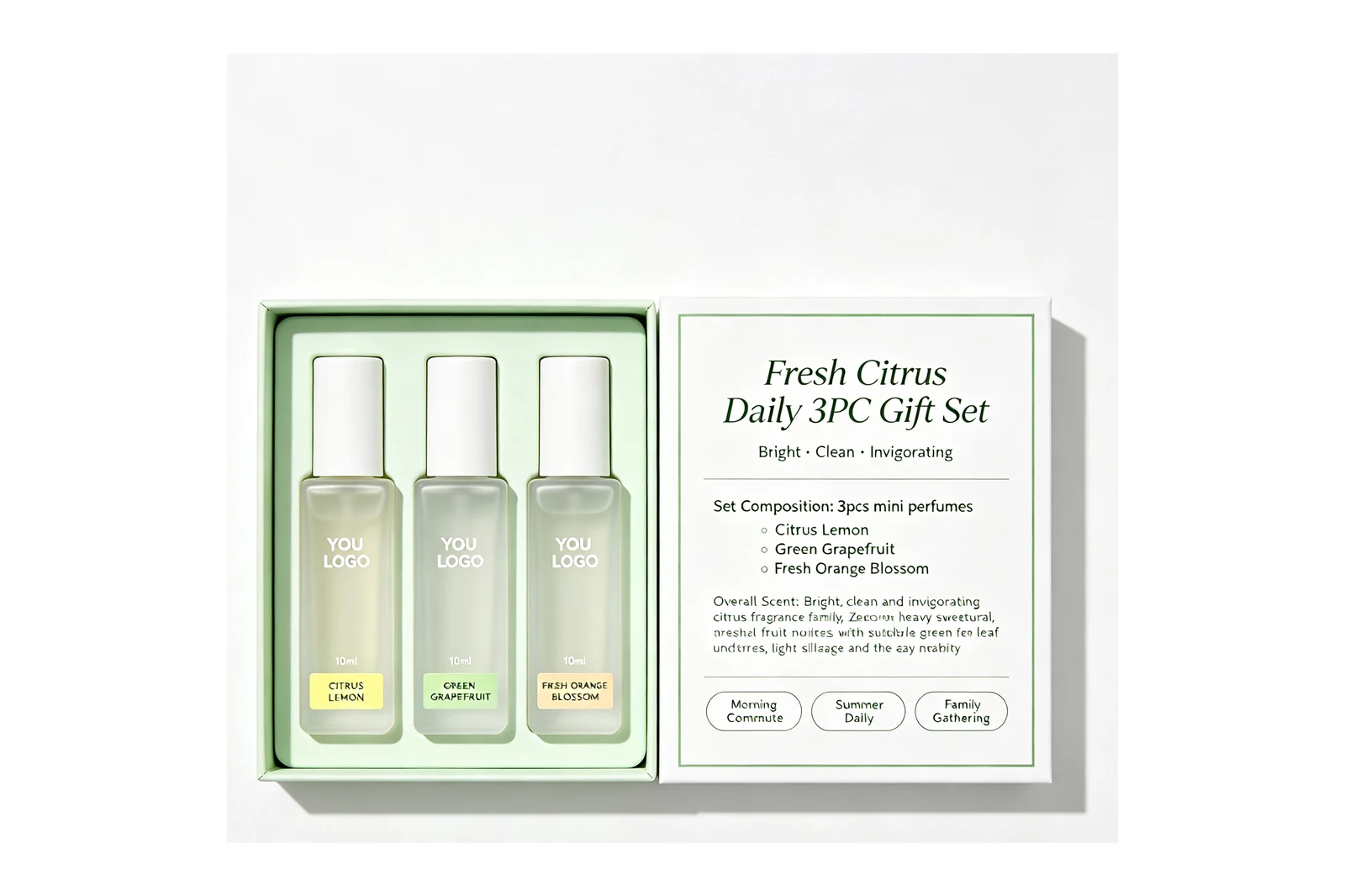
Folding carton, rigid box, sleeve, insert tray, shrink band. A rigid box is assembled by hand from greyboard and wrapped paper, which is why it costs several times what a folding carton does — and why it has a much higher minimum. For a launch run, a well-printed folding carton is usually the right answer; the rigid box can come with the gift set later.
5. Assembly and freight
Gift sets are hand-assembled: bottles placed in a tray, insert card folded, lid closed, shrink wrapped. That is labour, and it scales with the number of components rather than the number of millilitres. Then freight — glass is heavy and cartons are bulky, so you pay for air and volume as much as for the product.
Tooling: the cost that only hurts once
Moulds for glass and for caps, dies for hot stamping and die-cutting, screens or plates for printing, and the artwork and dieline work that precedes all of it. These are one-off charges, and they are the reason the same pack has a very different unit price at 1,000 units and at 50,000.
A tool is a fixed sum divided by your order quantity. At a low volume it is a visible part of the cost of every unit; at a high volume it disappears into rounding. This is the mechanism behind most of the “why is my minimum so high” conversations in this industry, and it is worth understanding before you ask a supplier to reduce a number that is being set by a mould shop you will never speak to.
Two questions to ask about any tooling charge. Who owns the tool after the order? If you paid for the mould, you should know where it lives and what happens if you move suppliers. What changes on a reorder? A first order carries set-up; a repeat should not. A supplier quoting the same minimum for both is charging you set-up twice.
Tooling also costs time, not just money. You cannot see a filled sample until the mould exists, and if the first shot needs correction you go around again. For a first launch that delay is usually a worse trade than the money.
Why short runs cost more per unit
Print is the quiet driver. A label run, a carton print run, a hot-stamp die, a screen set-up — all of them have minimums set by the printing supplier rather than by the cosmetics factory. Set-up time is fixed. Spread across a thousand units it is a real number per unit; spread across twenty thousand it is a rounding error.
The filling line behaves the same way. Below a certain run length, the line spends more time on changeover, cleaning and line clearance than it does filling, and the cost per unit climbs faster than the volume falls. Hand-filling is possible at small quantities, but it is a different process with a different cost base and a different consistency risk.
This is why packaging and minimum order quantity are the same conversation. The number you are quoted is usually a packaging number wearing a product label — the breakdown of what sets a fragrance MOQ follows the same four cost structures from the other direction.
Six decisions that cut cost without cheapening the pack
None of these makes a product look cheaper. All of them remove cost that a buyer was never going to notice in the first place.
- Use an existing bottle mould and spend the difference on the cap. The cap is what the buyer holds. A stock bottle with a distinctive closure reads as designed; a custom bottle with a stock cap reads as unfinished.
- Do one decoration properly instead of three adequately. A clean frost with a single-colour screen print will outperform frost plus foil plus emboss on both cost and coherence.
- Print directly on the bottle where the volume supports it. It removes a component, a supplier and a set-up — but only becomes economical once the run is long enough to absorb the print set-up.
- Ship the launch in a folding carton, keep the rigid box for the gift set. The carton protects the bottle and carries the brand; the rigid box is a gifting decision, not a shipping one.
- Share components across the range. One bottle family in two fill sizes shares caps, collars and cartons. Two unrelated bottles in similar sizes share nothing.
- Approve the dieline before the artwork. Reprints caused by artwork that did not fit the die are the most common avoidable cost in this category, and they are always discovered late.
What does not reduce packaging cost: asking for a discount on tooling, reusing a competitor’s quoted price as leverage, or specifying a premium pack and then trying to value-engineer it after the sample is approved. The last one is the expensive version of the first two.
What a packaging quotation should itemise
A single unit price cannot be compared with another single unit price unless both are built the same way. Ask for these lines separately, and compare like with like:
- Unit price at a stated quantity, plus the price at the next quantity break — so you can see what volume would buy you.
- Tooling, moulds and dies, listed one-off and with ownership stated.
- Print set-up and plates, which are frequently buried in the unit price and then charged again on a reorder.
- Samples: whether a packaging mock-up and a filled sample are both included, and how many revision rounds.
- Artwork and dieline preparation, and who is responsible for the dieline being correct.
- Minimum per component, not only per finished product — the binding constraint is often the carton or the cap, not the bottle.
- Freight basis and Incoterm, because glass makes weight and volume a material part of the landed cost.
The commercial questions that sit around the pack — payment terms, deposit, what happens if a delivery is late — are covered in the twelve-question supplier checklist. Read that before you sign anything, not after.
How we cost a perfume pack
We manufacture custom perfume to order at a minimum of 1,000 units, and we do not sell stock fragrance — which means the packaging is costed against your brief rather than matched to a catalogue. Samples are typically ready in 7–10 days from a confirmed brief, and the packaging is developed on that same brief rather than bolted on afterwards.
When you send a packaging brief we will tell you, part by part, which elements can use existing tooling and which need something new — and price both, so the decision is yours rather than hidden inside an average. Trial orders can be scheduled once the sample and the packaging are approved. The factory in Huadu runs to ISO 22716 and is certified to the FDA Cosmetic GMP Guidelines (2020); the six-step process shows where packaging sits in the timeline, and the gift set range shows how the secondary pack changes once you move from a single bottle to a set.
If you already have a bottle in mind, send us a photo or a link with the fill size and the finish you want. We will come back with the component breakdown, the parts that need tooling, and a price at your quantity — before you commit to a mould.
If you are scoping a private-label perfume line, our perfume OEM/ODM page covers concentration, packaging and the sampling path.
Bottle, neck finish and atomiser are set out together on the eau de parfum page, because they move the cost as one decision rather than three.
Related articles
Send us the pack, not just the scent
Tell us the bottle, the cap, the decoration and the carton you have in mind, with your target quantity. We will separate the parts that need new tooling from the parts that do not, and price the pack at 1,000 units and above.