Perfume OEM MOQ: what actually determines the minimum order?
Every fragrance project runs into the same wall eventually. The number is not arbitrary, and it is not a negotiating tactic — it falls out of four cost structures, and once you can see them you can see which ones are worth arguing about.
The short answer
A fragrance minimum order exists because four separate suppliers have to be paid before a single bottle is filled: the fragrance house, the glassworks, the printer, and the filling line. Each of them has a minimum, and the factory’s MOQ is essentially the point at which all four can be satisfied without the factory absorbing a loss.
That is why the number moves when you change the packaging and does not move when you change the scent. It also explains the most common experience in this category: two suppliers quote you wildly different minimums for what sounds like the same product. Usually they are not quoting the same product — one is quoting a stock fragrance in an existing bottle, the other is quoting a development project.
“Is this minimum for the product I described, or for your closest existing product?” A supplier quoting 500 units on a custom fragrance in a custom bottle is either misunderstanding the brief or planning to hand-fill from drums. Both are worth knowing before you plan a launch date.
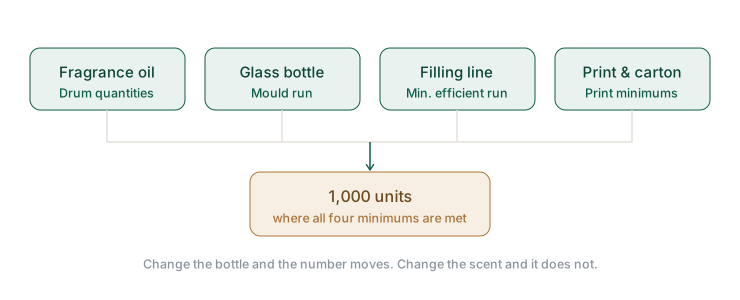
Four things set an MOQ, and only one is about the scent
1. The fragrance oil
Fragrance compound is bought in drum quantities, not by the litre. A compound also has to be macerated — left to settle so the blend stabilises — before it can be filled. Both of those create a floor: a formulator will not open a fresh compound for a few hundred bottles, because the oil purchase and the settling time cost the same whether the batch is 300 units or 3,000.
This is the one driver you can influence by choosing concentration. An eau de toilette at 8–12% fragrance oil uses materially less compound per unit than an eau de parfum at 15–20%, so the oil commitment for the same bottle count is smaller. If a supplier’s minimum is driven by oil cost, dropping a concentration tier can genuinely help.
2. The bottle
Existing mould or custom mould is the single biggest variable on this page, and it gets its own section below. In short: an existing mould has already been paid for by someone else, so your order only has to cover the glass. A new mould has to be cut, and the moulding factory will insist on a run large enough to justify the tooling.
3. The filling line
Automated filling lines have a minimum efficient run. Below that point, the line spends more time on changeover, cleaning and line clearance than it does filling, and the cost per unit climbs faster than the volume falls. A factory can fill 200 bottles by hand, but it is a different process with a different cost base — and usually a different quality risk profile, because hand-filling is harder to keep consistent.
4. Labels, cartons and decoration
Print is the quiet one. A label run, a carton print run, a hot-stamp die or a screen-print setup all have their own minimums, and they are set by the printing supplier rather than the cosmetics factory. A brief that asks for a custom-shaped carton with foil blocking has just added three minimums that have nothing to do with perfume.
Per SKU or per order — get this in writing
“MOQ 1,000” is not a complete statement. It matters enormously whether that 1,000 is the total for the order or the floor for each individual product.
If it is per order, a five-SKU range needs 1,000 bottles in total. If it is per SKU, the same range is a 5,000-unit commitment. That is a fivefold difference in cash and in warehouse space, and it is routinely left ambiguous in quotations because the ambiguity favours the supplier.
Ask for the basis explicitly, and ask a follow-up: does the minimum change when I choose a different bottle? A supplier who can answer both questions precisely has a real costing model. One who cannot is estimating.
Why a custom bottle doubles the number
A custom glass mould is a tooling project. It has to be designed, cut, sampled and corrected, and the moulding factory will want a production run that amortises that work. The result is that the glass supplier’s minimum, not the perfume factory’s minimum, becomes the binding constraint on your order.
There is a second, less obvious cost: time. Tooling adds weeks before you can even see a filled sample, and if the mould needs correction you go around again. For a first launch that is usually the wrong trade. Choosing an existing mould and putting the differentiation into the cap, the collar, the decoration and the carton gets you a distinct product without a tooling project — and keeps the minimum where the fragrance can support it. The component-by-component breakdown of packaging cost follows that trade-off in more detail.
What genuinely lowers an MOQ
- Choose an existing bottle mould. The largest single lever, usually worth more than everything else on this list combined.
- Standardise your fill volumes. A 50 ml and a 100 ml in the same bottle family share components; a 37 ml and a 73 ml share nothing.
- Launch one SKU, not five. Prove the scent sells before you commit to a range. This is the advice most first-time brands ignore and most second-time brands follow.
- Simplify the carton. A plain printed carton with a single ink has a much lower print minimum than a foiled, embossed, die-cut one.
- Accept a standard cap and collar. Custom caps are their own tooling project with their own minimum.
- Be flexible on timing. If you can accept a slot that fits around other production, a factory has more room to work with you than if the date is fixed.
What does not lower an MOQ, in our experience: asking for a discount on the minimum, asking for a sample order at production pricing, or pointing out that a competitor offered less. If a competitor offered less, the useful question is what exactly they offered it on — and the answer is usually a stock product in a stock bottle.
What 1,000 units does and does not include
An MOQ is a production quantity, not a price. Three things are usually separate and should be itemised in any quotation you accept:
- Development and sampling. Formulation work and sample batches are real costs. Ask whether they are credited back against the production order, and how many revision rounds are included before additional sample charges begin.
- Tooling and set-up. Moulds, dies and print set-up are one-off charges. Ask who owns the tooling afterwards — it should be clear, and it is often not you.
- Compliance and documentation. Stability and compatibility testing, the safety data sheet and the ingredient list are part of getting a product to market. Establish which of these are included before you compare two quotes.
A quote that hides these inside a unit price is not cheaper. It is just harder to compare — which is the point. The twelve-question checklist covers the rest of the commercial terms worth pinning down before a deposit.
Six questions to ask about any MOQ you are quoted
- Is the minimum per SKU or per order? Fivefold difference in commitment. Ask in writing.
- Does it change with the bottle? If yes, ask for the number for the bottle you actually want, not the one they quoted.
- What is the minimum for your existing moulds versus a new one? The gap tells you how much of the MOQ is tooling.
- What is included in the unit price, and what is invoiced separately? Development, tooling, testing, artwork and freight are the usual exclusions.
- What is the minimum for a repeat order? The first order carries set-up; repeats should not. A supplier who quotes the same minimum for both is charging you set-up twice.
- Can I see a filled sample at this quantity before I commit? A sample made on the real line, in the real bottle, is the only proof the process works at your volume.
How we set ours
Our minimum order quantity is 1,000 units, and we do not sell stock fragrance — every scent is developed against a brief, which is why we cannot go below a level that covers the compound and the line. Samples are typically ready in 7–10 days from a confirmed brief, and we confirm the production and shipping dates for a trial order in writing once the sample and the packaging are approved.
If you are launching several SKUs at once, ask us to break the minimum down product by product rather than quoting you a total — we would rather give you the real number for each line than a comfortable average. And if your budget only works at a few hundred units, we will say so early instead of taking a deposit and finding out later.
To see where the minimum sits in the wider project, read the six-step manufacturing process, look at the perfume OEM range, or start with how a fragrance brief is built. If you already know the direction, send us the brief and we will come back with a quantity, a sample timeline and a price on the same basis.
To see how MOQ, sampling and the first run actually work in practice, our perfume OEM/ODM page covers the full path from brief to bottle.
The eau de parfum format page shows what 1,000 units actually buys at a 25 to 30 percent oil load.
Related articles
Discuss your custom perfume project
Tell us the olfactive direction, the concentration, the bottle you have in mind and your target quantity. We will come back with the real minimum for that exact combination, not an average.